
Understanding how term life insurance works is important before buying a policy for your family. Many people know they need life insurance, but they are not always clear about premium payments, death benefits, beneficiaries, policy length, or how the payout works.
Term life insurance is one of the simplest types of life insurance. It gives coverage for a fixed period, such as 10, 20, or 30 years. If the insured person dies during the active policy term, the insurance company pays a death benefit to the named beneficiary. If the insured person outlives the term, coverage usually ends unless the policy can be renewed, converted, or replaced.
This guide explains term life insurance coverage in simple language, including what it covers, how long it lasts, how premiums work, how beneficiaries receive the payout, and what happens in common scenarios.
How Term Life Insurance Works: Quick Overview
Term coverage life insurance works like a financial safety net. You pay regular premiums to keep the policy active. In return, the insurer agrees to pay a death benefit if the insured person dies during the policy term and the claim meets policy rules.
| Key Part | What It Means |
| Premium | Payment made to keep the policy active |
| Death Benefit | Money paid to beneficiaries after a covered death |
| Beneficiary | Person or entity receiving the payout |
| Policy Term | Length of time the coverage lasts |
| Coverage Amount | Total protection selected |
| Payout | Claim payment made after the insured person dies |
The main purpose is income protection. A term life insurance payout can help a family pay bills, replace income, cover a mortgage, manage debts, and handle future expenses.
What Is Term Life Insurance Coverage?
Term life insurance coverage is temporary life insurance protection. It covers the insured person for a specific period rather than for their entire life. If death happens during the term, the policy may pay the selected death benefit.
Term coverage life insurance is often used by people who want affordable protection during their most financially responsible years. This may include raising children, paying a mortgage, supporting a spouse, or building savings.
Unlike many permanent life insurance policies, term life insurance usually has no cash value. It is mainly designed to provide protection, not investment growth. That is one reason term policies often cost less than whole life or universal life insurance.
If you want affordable protection for your family, mortgage, or income replacement needs, you can explore flexible term life insurance coverage options designed around your financial responsibilities.
How Does a Term Life Insurance Policy Work?
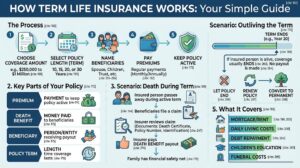
If you are asking how does a term life insurance policy work, the process is simple.
First, you choose a coverage amount. This is the death benefit your beneficiaries may receive. For example, you may choose $250,000, $500,000, or $1 million based on your family’s needs.
Second, you choose the policy length. Common term life insurance duration options include 10, 15, 20, and 30 years.
Third, you name beneficiaries. These are the people or entities that receive the term life insurance payout if you die during the policy term.
Fourth, you pay premiums. Premiums may be paid monthly or annually. If premiums are not paid, the policy may lapse after the grace period.
Finally, if the insured person dies while the policy is active, beneficiaries file a claim with the insurance company.
What Does Term Life Insurance Cover?
What does term life insurance cover? It covers the financial risk of the insured person dying during the policy term. The payout can usually be used by beneficiaries for many needs.
A term life insurance payout may help cover:
- Mortgage payments
- Rent and utilities
- Groceries and household bills
- Childcare expenses
- Children’s education costs
- Car loans and credit cards
- Funeral and final expenses
- Family income replacement
- Business loan obligations
- Daily living costs
The insurance company does not usually control how beneficiaries spend the money after the claim is approved. The death benefit is meant to give loved ones financial stability when income or support is lost.
How Long Is Term Life Insurance?
How long is term life insurance? The answer depends on the policy you choose. Most term policies last for a fixed number of years.
| Term Length | Best For |
| 10 Years | Short term debt, business loan, or coverage near retirement |
| 15 Years | Families with older children or smaller mortgages |
| 20 Years | Parents wanting protection until children become adults |
| 30 Years | Young families, new homeowners, and long mortgage protection |
How long does term life insurance last is one of the most common questions buyers ask. The right policy length should match your major responsibilities. For example, if you have a 30 year mortgage, a 30 year term may make sense. If your children will be financially independent in 15 years, a 15 or 20 year term may be enough.
In simple words, the answer to how long life insurance term should be depends on your income, dependents, debts, mortgage, and future plans.
How Premiums Work in Term Life Insurance
A premium is the payment you make to keep your life insurance policy active. You may pay monthly, quarterly, semi annually, or annually, depending on the insurance company.
Most level term life insurance policies have premiums that stay the same during the selected term. That makes budgeting easier.
| Premium Factor | How It Affects Cost |
| Age | Older applicants usually pay more |
| Health | Healthier applicants may get better rates |
| Smoking Status | Tobacco use usually increases premiums |
| Coverage Amount | Higher death benefit usually costs more |
| Policy Length | Longer terms usually cost more |
| Lifestyle and Occupation | Higher risk may increase pricing |
Buying early can help because age and health affect pricing. A young, healthy applicant usually has a better chance of qualifying for lower premiums.
What Happens If You Miss a Premium?
If you miss a premium, the policy usually enters a grace period. A grace period is a short amount of time when you can still make the payment before coverage ends.
If the payment is not made during the grace period, the policy may lapse. A lapsed policy usually means your beneficiaries will not receive a payout if you die after coverage ends.
Some insurers may allow reinstatement, but reinstatement may require payment of overdue premiums, proof of insurability, or a new review.
How the Death Benefit Works
The death benefit is the amount of money paid to beneficiaries if the insured person dies during the policy term. This is the main protection provided by term life insurance.
For example, if you buy a $500,000 term life insurance policy and die while the policy is active, your beneficiary may receive $500,000, subject to the policy terms and claim approval.
The death benefit is usually paid as a lump sum, but some insurers may offer other payout options. Beneficiaries can use the money for immediate expenses, long term support, debt repayment, or savings.
How Does Term Life Insurance Payout?
How does term life insurance payout? The payout begins with a claim. After the insured person dies, the beneficiary contacts the insurance company and submits required documents.
Documents may include:
- Claim form
- Certified death certificate
- Policy number
- Beneficiary identification
- Any documents requested by the insurer
The insurance company reviews the claim. If the policy was active, premiums were paid, beneficiaries are valid, and no exclusions apply, the death benefit is paid.
A payout may be delayed if documents are missing, beneficiary information is unclear, the policy is in the contestability period, or there is a dispute.
Who Are Beneficiaries in Term Life Insurance?
A beneficiary is the person or entity chosen to receive the term life insurance payout. You can usually name one or more beneficiaries.
A primary beneficiary receives the payout first. A contingent beneficiary receives the payout if the primary beneficiary has died or cannot receive the money.
Common beneficiary choices include:
- Spouse
- Adult children
- Trust
- Business partner
- Charity
- Estate
Beneficiary details should be reviewed after marriage, divorce, birth of a child, death of a beneficiary, or major financial changes. If no valid beneficiary is listed, the payout may go to the estate and may face delays.
What Happens If You Outlive Your Term Life Insurance Policy?
If you outlive your term life insurance policy, coverage usually ends. Since term life insurance is designed for protection during a fixed period, there is usually no payout when the insured person is still alive at the end of the term.
At that point, you may have several options:
- Let the policy end
- Renew the policy if allowed
- Convert the policy if it has a conversion option
- Buy a new term policy
- Move to permanent life insurance
- Reduce coverage if your needs are lower
Outliving the policy is not a bad thing. It often means the policy protected your family during the years when they needed it most.
What Happens If You Die During the Policy Term?
If you die during the active term, your beneficiaries can file a claim. The insurer will review the death certificate, policy status, beneficiary records, and any relevant policy terms.
If the claim is approved, the death benefit is paid. This money can help your family continue living with less financial pressure.
This is the core reason people buy term life insurance coverage: to make sure loved ones are not left without income or support.
What Happens If Your Health Changes After Buying?
If your health changes after buying a level term life insurance policy, your premium usually stays the same during the level term. That is one reason buying while you are healthy can be helpful.
However, if you need new coverage later, your new rate may be based on your current age and health. If your policy includes a conversion option, you may be able to convert to permanent life insurance without a new medical exam.
What Happens If You Need More Coverage Later?
Life changes. You may need more coverage after marriage, a new child, a new mortgage, a business loan, higher income, or more debt.
You may be able to:
- Buy an additional term policy
- Replace an existing policy
- Convert some coverage to permanent insurance
- Add coverage through work
- Review your full financial protection plan
It is smart to review coverage every year or after major life events.
Term Life Insurance vs Permanent Life Insurance
Term life insurance is not the same as whole life or universal life insurance. Term coverage is temporary and usually more affordable. Permanent life insurance can last for life and may build cash value.
| Feature | Term Life Insurance | Whole or Universal Life Insurance |
| Coverage Length | Fixed term | Lifetime if maintained |
| Cash Value | Usually none | Usually yes |
| Premium Cost | Usually lower | Usually higher |
| Simplicity | Easier to understand | More complex |
| Best Use | Temporary protection | Long term planning |
Term life insurance works well when your financial need has an end date. Permanent coverage may be better if you need lifetime protection, estate planning, or cash value.
Benefits of Term Life Insurance
Term life insurance is popular because it is simple and affordable for many families.
Key benefits include:
- Lower premiums compared to many permanent policies
- Easy to understand structure
- High coverage for lower cost
- Good for mortgage protection
- Useful for parents with children
- Flexible term lengths
- Helpful for income replacement
It gives families protection during the years when financial responsibilities are highest.
Limitations of Term Life Insurance
Term life insurance also has limits.
Common limitations include:
- Coverage ends after the term
- Usually no cash value
- Renewal can be expensive
- New coverage may require underwriting
- Not ideal for lifelong needs
- Policy can lapse if premiums are missed
This does not make term life insurance a poor choice. It simply means it should match your goal.
How to Choose the Right Term Life Insurance Policy
Choosing the right policy starts with your family’s needs. Think about income, debts, mortgage, children, savings, and future expenses.
Use this checklist:
- How much income should be replaced?
- How many years should coverage last?
- Who should receive the death benefit?
- Can the policy be renewed?
- Can the policy be converted?
- What exclusions apply?
- What happens if a premium is missed?
- Is the coverage enough for your family?
The best term life insurance policy is not always the cheapest one. It is the one that fits your budget while protecting your loved ones properly.
Common Mistakes to Avoid
Avoid these mistakes when buying term life insurance:
- Buying too little coverage
- Choosing a term that is too short
- Waiting too long to buy
- Not updating beneficiaries
- Ignoring policy exclusions
- Depending only on employer coverage
- Missing premium payments
- Not reviewing coverage after life changes
A small mistake in beneficiary details or policy length can create major problems later.
Final Thoughts
How term life insurance works is simple once you understand the main parts. You choose coverage, select a policy term, name beneficiaries, pay premiums, and keep the policy active. If you die during the term, your beneficiaries may receive the death benefit.
Term life insurance coverage is especially useful for income replacement, mortgage protection, debt repayment, and family security. It is often a practical choice for parents, homeowners, business owners, and anyone with dependents.
The right policy should match your real financial responsibilities. Choose the coverage amount, term life insurance duration, and beneficiary setup carefully so your family has protection when they need it most.
FAQs
How does term life insurance work?
Term life insurance works by providing coverage for a fixed period. If the insured person dies during the active term, the insurer pays a death benefit to the beneficiary.
How does a term life insurance policy work?
You choose a coverage amount, select a term length, name beneficiaries, and pay premiums. If death occurs during the term, beneficiaries can file a claim.
What does term life insurance cover?
It covers the financial risk of death during the policy term. The payout can help with income replacement, mortgage payments, debt, education, and final expenses.
How long is term life insurance?
Common term lengths include 10, 15, 20, and 30 years. The right term depends on your financial responsibilities.
How long does term life insurance last?
It lasts for the selected policy term, as long as premiums are paid and the policy remains active.
What is term life insurance duration?
Term life insurance duration means the length of time the policy provides coverage.
How does term life insurance payout?
Beneficiaries file a claim with the insurer, provide required documents, and receive the death benefit if the claim is approved.
Who receives the term life insurance payout?
The named beneficiary receives the payout. This may be a spouse, child, trust, business partner, charity, or estate.
What happens if I outlive my term policy?
Coverage usually ends. You may renew, convert, buy a new policy, or let coverage stop if you no longer need it.
What happens if I stop paying premiums?
The policy may enter a grace period. If payment is not made, coverage may lapse and the death benefit may no longer be available.