
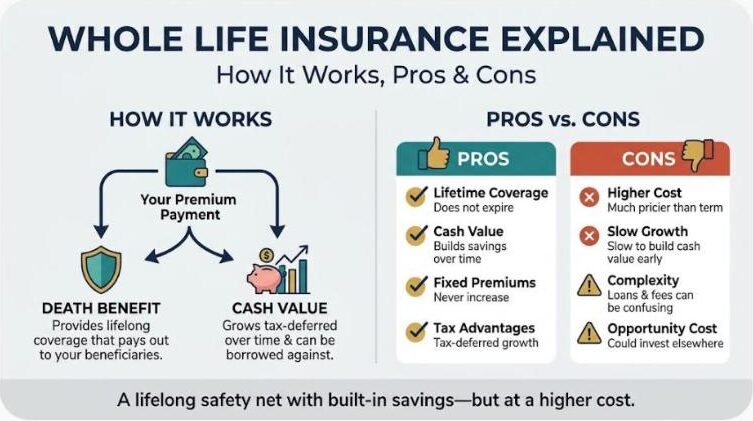
Whole life insurance is the most traditional form of permanent life insurance, offering lifelong coverage, level premiums, and a guaranteed cash value account that grows every single year. This guide explains exactly how whole life insurance works, what it costs, how the cash value builds over time, and how to decide whether it belongs in your financial plan.
What Is Whole Life Insurance?
Whole life insurance is a type of permanent life insurance designed to provide coverage for your entire life, rather than a limited number of years. As long as you keep paying the premiums, the policy stays in force and your beneficiaries are guaranteed a death benefit, regardless of when you pass away.
Unlike term insurance, whole life insurance also builds cash value, a savings component inside the policy that grows on a tax-deferred basis at a guaranteed minimum rate set by the insurer.
How Does Whole Life Insurance Work?
Each premium payment is divided by the insurance company into three parts: the cost of the pure death benefit protection, the insurer’s administrative fees and profit margin, and a contribution to your policy’s cash value. Over time, the cash value portion grows larger relative to the cost of insurance, which is why cash value accumulation accelerates in the later years of the policy.
The Death Benefit
This is the guaranteed, tax-free payout your beneficiaries receive when you pass away, as long as premiums have been paid. Many policies allow you to choose a level death benefit or one that increases alongside the cash value.
The Cash Value
Cash value grows slowly in the early policy years and accelerates over time. You can access it while you are alive through a policy loan, a partial withdrawal, or by surrendering the policy entirely. Unlike a death benefit, cash value is not automatically paid out to beneficiaries in addition to the face amount in most standard policies.
Dividends (Participating Policies)
Whole life policies issued by mutual insurance companies are often “participating,” meaning policyholders may receive annual dividends based on the insurer’s financial performance. Dividends are not guaranteed, but many mutual insurers have paid them consistently for decades. Dividends can be taken as cash, used to reduce premiums, left to accumulate with interest, or used to purchase additional paid-up coverage.
Types of Whole Life Insurance
- Non-participating whole life: Fixed premiums and guaranteed cash value growth, but no dividends.
- Participating whole life: Includes the potential for annual, non-guaranteed dividends.
- Limited-pay whole life: Premiums are paid for a set number of years, such as 10 or 20, after which the policy is fully paid up while coverage continues for life.
- Single-premium whole life: The entire policy is funded with one lump-sum payment, often used for estate planning or wealth transfer.
How Whole Life Insurance Cash Value Grows
Cash value growth is slow in the first few years because early premiums primarily cover the cost of insurance and the insurer’s fees. Growth typically accelerates after year five to ten. As an illustration, a $250,000 policy purchased by a healthy 35-year-old might build cash value roughly as follows, though actual figures vary by insurer and policy design:
| Policy Year | Approximate Cash Value |
|---|---|
| Year 5 | $6,000 – $10,000 |
| Year 10 | $18,000 – $26,000 |
| Year 20 | $55,000 – $75,000 |
| Year 30 | $110,000 – $150,000 |
These figures are illustrative only. Your insurer will provide a personalized illustration showing guaranteed and projected cash value growth before you purchase a policy.
Pros of Whole Life Insurance
- Coverage lasts your entire lifetime as long as premiums are paid
- Premiums never increase, no matter your age or health changes later
- Cash value grows on a guaranteed, tax-deferred basis
- Participating policies may pay dividends that boost value further
- Cash value can be borrowed against for emergencies, opportunities, or retirement income
- Can support estate planning, business succession, and final expense needs
Cons of Whole Life Insurance
- Premiums are significantly higher than term life insurance for the same death benefit
- Cash value grows slowly, especially in the first several years
- Policy loans that are not repaid reduce the death benefit and can trigger taxes if the policy lapses
- Less flexible than universal life insurance if your budget or needs change
- Surrendering the policy early often triggers surrender charges and forfeits most of the cash value built so far
Whole Life Insurance vs. Term Life Insurance
Term life insurance is temporary and far less expensive, making it a better fit for covering a specific period such as the years you have a mortgage or dependent children. Whole life insurance costs more but never expires and builds cash value, making it better suited to lifelong needs like estate planning, final expenses, or guaranteed savings. Many families use both: term for large, temporary protection needs and a smaller whole life policy for lifelong coverage.
Whole Life Insurance vs. Universal Life Insurance
Universal life insurance is another form of permanent coverage, but it offers flexible premiums and an adjustable death benefit, with cash value growth tied to current interest rates rather than a fixed guarantee. Whole life insurance trades that flexibility for predictability: your premium and guaranteed growth rate are locked in from day one and never change.
Who Should Consider Whole Life Insurance?
- People who want lifelong coverage that will never expire or need renewal
- Parents or grandparents planning to leave a guaranteed inheritance
- Business owners using life insurance for succession or buy-sell agreements
- Individuals who have already maximized contributions to retirement accounts and want additional tax-advantaged savings
- Anyone who values guarantees over potentially higher but uncertain investment returns
How to Buy Whole Life Insurance: What to Compare
- The insurer’s financial strength rating from agencies such as A.M. Best or Moody’s
- Whether the policy is participating (dividend-eligible) or non-participating
- Guaranteed cash value illustrations versus non-guaranteed projections
- Premium payment options, including limited-pay structures
- Available riders, such as waiver of premium, accelerated death benefit, or paid-up additions
Common Mistakes to Avoid
- Buying whole life insurance before funding an emergency fund or paying off high-interest debt
- Underestimating how slowly cash value grows in the early years
- Treating policy loans as free money without a plan to repay them
- Letting a policy lapse after years of premiums, forfeiting most of its value
Frequently Asked Questions
Can I borrow money from my whole life insurance policy?
Yes. Once sufficient cash value has accumulated, most insurers allow you to take a policy loan against it, typically at a competitive interest rate. Unpaid loan balances are deducted from the death benefit if you pass away before repaying them.
What happens if I stop paying premiums on a whole life policy?
If you stop paying premiums, the policy may lapse, or it may continue temporarily using accumulated cash value or dividends, depending on the policy’s terms. Some policies also offer a reduced paid-up option that lowers the death benefit but keeps coverage in force without further premiums.
Is whole life insurance worth it?
Whole life insurance can be worth it for people who want guaranteed, lifelong coverage and a conservative savings vehicle, but it is generally not the most cost-efficient way to buy pure protection or to maximize investment growth. It works best as part of a broader financial plan rather than a sole savings strategy.
How much does a whole life insurance policy cost?
Cost depends heavily on your age, health, and the death benefit amount. As a rough guide, a healthy 35-year-old might pay $300 to $500 a month for $250,000 of coverage, significantly more than an equivalent term policy.
Can I cash out my whole life insurance policy?
Yes, you can surrender the policy for its cash surrender value, though this ends your coverage and may involve surrender charges in the early years, as well as potential tax consequences if the cash value exceeds the premiums you paid.
Final Thoughts
Whole life insurance offers something few other financial products can: a guarantee that lasts as long as you do. That security comes at a cost, both in higher premiums and in slower early growth, so it tends to work best for people with a clear lifelong need, such as estate planning or guaranteed final expense coverage, rather than as a first or only life insurance purchase. Comparing illustrations from several highly rated insurers is the best way to see exactly what a policy would guarantee for your age and health.