
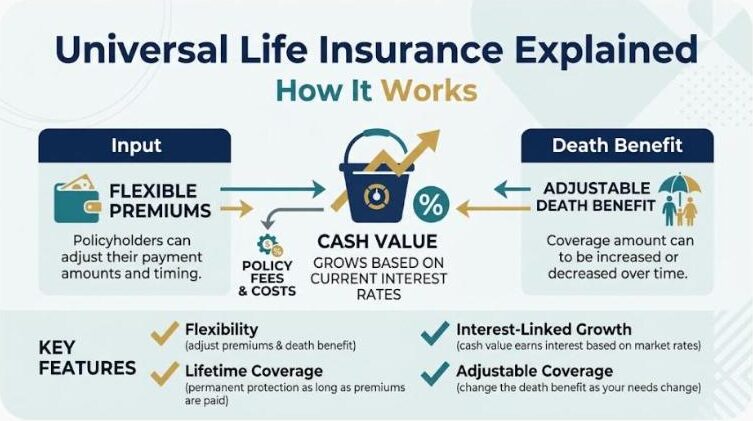
Universal life insurance is a flexible form of permanent coverage that lets you adjust your premium payments and death benefit as your life changes, while building cash value along the way. This guide explains how universal life insurance actually works, the different types available, and how to decide whether its flexibility is worth the trade-offs.
What Is Universal Life Insurance?
Universal life (UL) insurance is a type of permanent life insurance that combines a death benefit with a cash value account, similar to whole life insurance. The key difference is flexibility: universal life policies let you increase or decrease your premium payments within limits, and adjust your death benefit, as long as the policy has enough cash value to cover the cost of insurance and fees.
How Does Universal Life Insurance Work?
Every premium payment you make is deposited into the policy’s cash value account. From that account, the insurer deducts the cost of insurance (the actual cost of the death benefit, which rises as you age) and administrative charges. Whatever remains earns interest, which is credited to your cash value based on the policy’s crediting method. As long as the cash value is sufficient to cover the monthly deductions, the policy stays in force, even if you skip or reduce a premium payment.
This flexibility cuts both ways. If you consistently pay less than the policy needs, or if the credited interest rate drops, the cash value can be depleted faster than expected, causing the policy to lapse unless you increase premiums or add a lump sum.
Types of Universal Life Insurance
Guaranteed Universal Life (GUL)
Designed primarily for the death benefit guarantee rather than cash value growth. As long as you pay the specified premium, coverage is guaranteed to a certain age, such as 90, 95, or even 121, often at a lower cost than whole life insurance for the same guarantee.
Indexed Universal Life (IUL)
Cash value growth is linked to the performance of a stock market index, such as the S&P 500, subject to a cap on maximum gains and a floor that protects against market losses, often 0%. This offers higher growth potential than traditional UL, with more risk and complexity.
Variable Universal Life (VUL)
Cash value is invested directly in sub-accounts similar to mutual funds, offering the highest growth potential but also the risk of losing cash value if investments perform poorly. VUL requires active management and carries more investment risk than any other permanent policy type.
Pros of Universal Life Insurance
- Flexible premiums that can be increased, decreased, or skipped within limits
- Ability to adjust the death benefit up or down as your needs change
- Cash value grows on a tax-deferred basis
- Indexed and variable versions offer higher growth potential than whole life insurance
- Guaranteed UL can provide lifelong coverage at a lower cost than traditional whole life
Cons of Universal Life Insurance
- Flexibility can lead to underfunding and unexpected policy lapse if not monitored
- Cost of insurance charges increase with age and can erode cash value over time
- Indexed and variable versions are more complex and carry more risk than whole life insurance
- Non-guaranteed interest crediting rates can fall, requiring higher premiums than originally illustrated
- Surrender charges typically apply if you cancel the policy in its early years
Universal Life Insurance vs. Whole Life Insurance
Whole life insurance offers guaranteed premiums and guaranteed cash value growth that never changes, trading flexibility for certainty. Universal life insurance offers the ability to adjust premiums and death benefits over time, but its cash value growth and even its guarantees often depend on current interest rates or market performance, which means it generally requires more ongoing attention from the policyholder.
Universal Life Insurance vs. Term Life Insurance
Term life insurance is temporary and far less expensive, built purely for protection with no cash value. Universal life insurance costs more but never expires (as long as it is funded correctly) and builds cash value you can access while you are alive. Many people use term insurance for large, temporary needs and consider universal life insurance only once they have a specific lifelong or flexible coverage goal.
Who Should Consider Universal Life Insurance?
- People who want lifelong coverage but also want the flexibility to adjust premiums as income changes
- Business owners who need permanent coverage for succession planning with adjustable funding
- Those comfortable monitoring a policy’s performance and adjusting premiums if the cash value runs low
- People seeking potentially higher cash value growth than whole life insurance through indexed or variable options, and willing to accept the added risk
How to Buy Universal Life Insurance: What to Compare
- Guaranteed versus current (non-guaranteed) cost of insurance charges and interest rates
- The insurer’s financial strength rating
- Caps, floors, and participation rates for indexed universal life policies
- Whether the policy includes a no-lapse guarantee rider, and under what conditions it stays in force
- In-force illustrations showing projected performance at both guaranteed and current assumptions
Common Mistakes to Avoid
- Paying only the minimum premium shown in an initial illustration without monitoring the policy over time
- Assuming non-guaranteed interest crediting rates will stay the same for decades
- Choosing indexed or variable universal life without understanding caps, floors, or investment risk
- Ignoring annual in-force illustrations that show whether the policy is on track or at risk of lapsing
Frequently Asked Questions
Can universal life insurance lapse?
Yes. If the cash value is not large enough to cover the monthly cost of insurance and fees, the policy can lapse even if you believed you were adequately funding it. This is one of the most important risks to monitor with universal life insurance.
Is indexed universal life insurance a good investment?
Indexed universal life insurance is primarily a life insurance product with a cash value feature linked to index performance, not a direct market investment. Caps on gains mean it typically will not match full stock market returns in strong years, though the floor protects against market losses.
What happens if I stop paying premiums on universal life insurance?
If the policy has enough accumulated cash value, it can continue to cover the cost of insurance and fees for a period without new premiums. Once the cash value is depleted, the policy will lapse unless you resume payments or it includes an active no-lapse guarantee.
How is universal life insurance different from term life insurance?
Universal life insurance is permanent, builds cash value, and offers adjustable premiums and death benefits, while term life insurance is temporary, has no cash value, and offers a fixed premium and death benefit for a set number of years.
Can I withdraw money from a universal life insurance policy?
Yes, most policies allow partial withdrawals or policy loans against the cash value, though withdrawals can reduce the death benefit and loans accrue interest that reduces the benefit if unpaid.
Final Thoughts
Universal life insurance can be a powerful tool for people who want lifelong coverage with the flexibility to adapt premiums and death benefits to their changing circumstances, but that flexibility requires active monitoring to avoid an unexpected lapse. Reviewing annual in-force illustrations and comparing guaranteed versus projected performance with a licensed agent can help ensure your policy stays on track for life.