
What Is Gap Insurance?
Gap insurance — short for Guaranteed Asset Protection — is an optional auto insurance add-on that pays the difference between your car's actual cash value (ACV) at the time of a total loss and the amount you still owe on your auto loan or lease. Not sure if your current policy already includes it? A licensed insurance advisor at Future Proof can review your coverage in minutes and flag any gaps before they cost you.
How Gap Insurance Works
When your car is stolen or declared a total loss after an accident, your standard comprehensive or collision coverage pays out based on the car's current market value — not its original purchase price. If your loan balance is higher than that payout, you're left personally responsible for the remaining amount. Gap insurance steps in to cover that leftover balance.
What "Gap" Actually Means
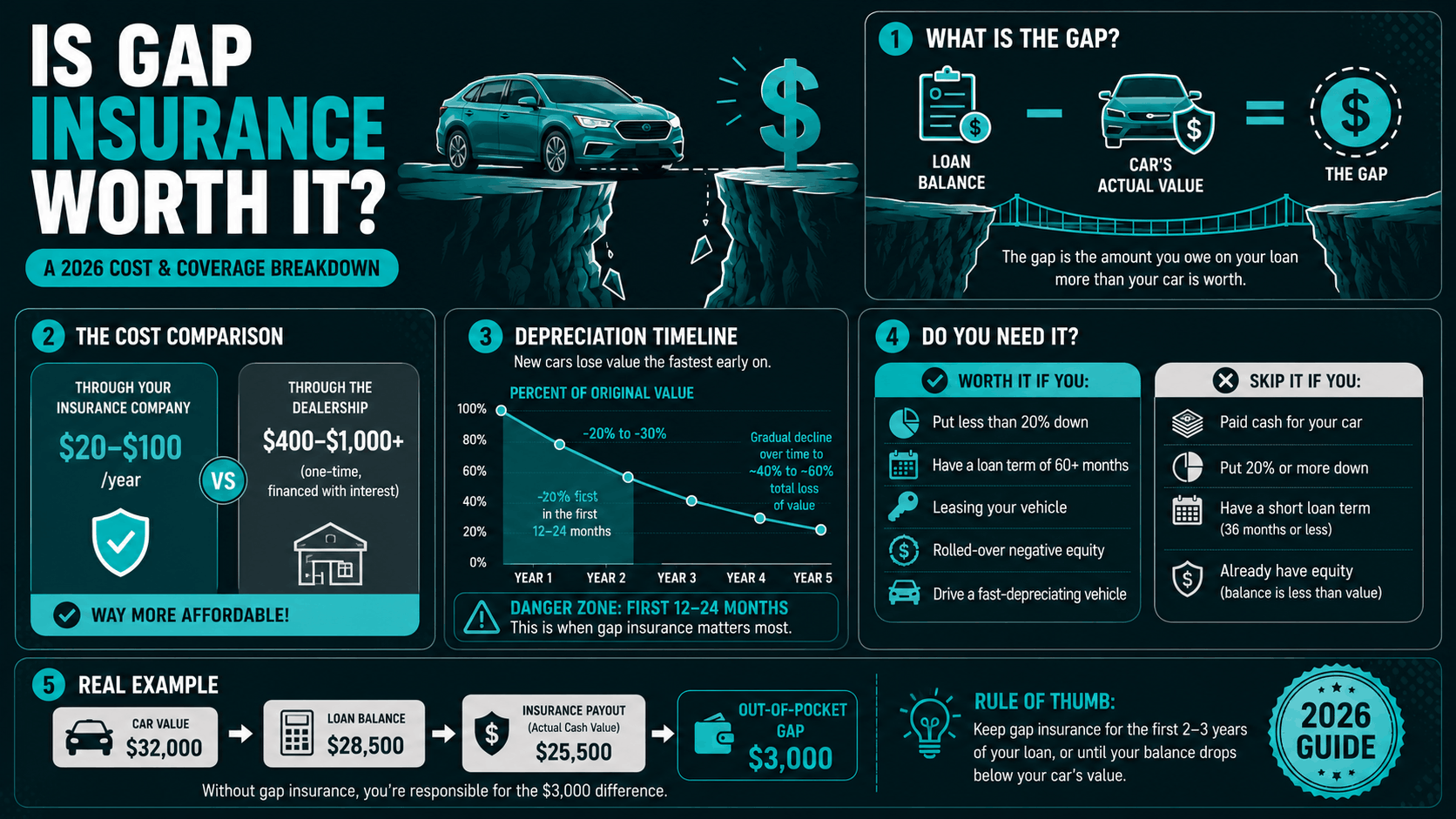
The gap is simply: Loan or Lease Payoff Balance − Actual Cash Value (ACV) at Time of Loss = The Gap. Because new vehicles depreciate fastest in the first year or two, this gap is usually widest early in a loan — especially with a small down payment or a long loan term.
| Covered | Not Covered |
|---|---|
| Difference between loan/lease balance and car's ACV | Your insurance deductible (unless specifically included) |
| Remaining loan balance after a total loss payout | Missed or late loan payments |
| Lease-end payoff shortfall (if lease requires it) | Negative equity rolled over from a previous vehicle loan |
| — | Mechanical breakdowns or repairs |
| — | Extended warranties or service contracts financed into the loan |
How Does Gap Insurance Work in a Total Loss Claim?
Actual Cash Value (ACV) Explained
Actual cash value is what your insurer determines your car was worth right before it was totaled or stolen — factoring in depreciation, mileage, condition, and market comparables. It is almost always lower than what you originally paid or currently owe.
Example Scenario
Say you buy a car for $32,000 with a small down payment and finance the rest over 72 months. A year later, the car is totaled in an accident.
| Item | Amount |
|---|---|
| Original purchase price | $32,000 |
| Loan balance after 1 year | $28,500 |
| Actual cash value (car depreciated ~15–20%) | $26,000 |
| Insurance payout (ACV minus $500 deductible) | $25,500 |
| Out-of-pocket gap without coverage | $3,000 |
Without gap insurance, you'd owe $3,000 to your lender for a car you no longer have. With gap insurance, that $3,000 is paid on your behalf.
Is Gap Insurance Worth It? Key Factors to Consider
When It's Worth It
- You made a down payment of less than 20%
- Your loan term is 60 months or longer
- You're leasing a vehicle
- You rolled negative equity from a previous loan into your new financing
- Your vehicle depreciates quickly (luxury cars, EVs, performance models)
- You bought a car with low resale value relative to its price
When It's NOT Worth It
- You paid cash for the vehicle
- You made a large down payment (20%+)
- You have a short loan term (36 months or less)
- Your loan balance is already lower than the car's current value
- You've owned the car for several years and built up equity
- Your car is known to hold its value well
Depreciation Rate and Why It Matters
Depreciation is the single biggest factor driving whether you'll ever actually need gap coverage. According to 2026 industry data from Carfax, new vehicles lose about 12.5% of their value in the first year, while Edmunds and Kelley Blue Book estimate first-year depreciation closer to 20–23.5% depending on the vehicle. Across the board, most sources agree that a new car loses roughly 20–30% of its value within the first two years and around 40–60% by year five.
Because loan balances decrease slowly in the early months (especially with long terms or small down payments) while the car's value drops quickly, the gap is usually at its widest during the first 12–24 months of ownership — exactly when gap insurance provides the most value.
Do I Need Gap Insurance?
Financed Cars
If you financed your car, especially with a loan of 60 months or longer or a down payment under 20%, there's a real chance you'll be "upside down" (owing more than the car is worth) for a significant stretch of the loan. This is the most common scenario where gap insurance pays off.
Leased Cars — Is It Required?
Leased vehicles are the one category where gap coverage is frequently mandatory. Many leasing companies build gap coverage directly into the lease contract. Check your lease agreement first — if gap protection is already included, buying a separate policy means paying for duplicate coverage.
Cars Bought With Cash
If you paid cash, there's no loan balance to protect — so gap insurance offers no financial benefit. It's designed specifically to protect a lender's (or your) interest in an outstanding loan or lease balance.
Down Payment & Loan Term Impact
The size of your down payment and the length of your loan term are the two biggest levers that determine how long — and how deep — you stay "underwater" on your vehicle.
| Scenario | Gap Risk Level |
|---|---|
| 20%+ down payment, 36-month loan | Low |
| 10–19% down payment, 48-month loan | Moderate |
| Under 10% down payment, 60+ month loan | High |
| $0 down, 72–84 month loan, negative equity rolled in | Very High |
How Much Does Gap Insurance Cost?
Gap insurance is one of the cheapest add-ons in the auto insurance world — but the price varies dramatically depending on where you buy it.
Average Cost Through an Insurance Company
Multiple 2026 industry sources converge on a similar range when gap coverage is added to an existing auto policy:
| Source | Average Annual Cost |
|---|---|
| Insurance Information Institute (III) | ~$20–$40/year |
| Insure.com industry average | ~$88/year |
| CarInsurance.com average | ~$99/year |
| Typical range across major insurers | $20–$208/year |
Typical range: $20–$100/year (~$2–$8/month)
Most drivers can expect to pay somewhere between $20 and $100 per year when gap coverage is bundled into a comprehensive and collision policy through a major insurer like Progressive, State Farm, Allstate, or Travelers. Want to know your exact number? Get a personalized gap insurance quote based on your vehicle, loan balance, and state.
Average Cost Through a Dealership
Dealerships and lenders typically sell gap coverage as a flat, one-time fee rolled into your auto loan:
| Purchase Point | Typical Cost |
|---|---|
| Dealership F&I office | $400–$1,000+ |
| Vehicle manufacturer/lender add-on | ~$450 average |
Because this fee is financed into your loan, you also pay interest on it for the life of the loan, making it effectively far more expensive than the sticker price suggests. Several sources note dealership markups can run 5 to 10 times what the same coverage costs through an insurer.
Factors That Affect Gap Insurance Pricing
- Vehicle type — luxury, performance, and electric vehicles depreciate faster and often cost more to insure
- Vehicle age — newer vehicles depreciate faster in the first few years, raising perceived risk
- Loan amount and term — larger loans and longer terms increase potential exposure
- State of residence — rates vary significantly; Texas averages around $69–$70/year while Michigan and Montana have reported rates well above $140–$400/year depending on the insurer
- Where you buy it — insurer add-on vs. dealership flat fee
Where to Buy Gap Insurance (Dealer vs. Insurer)
| Factor | Dealership | Insurance Company |
|---|---|---|
| Typical cost | $400–$1,000+ flat fee | $20–$100/year |
| Payment structure | Rolled into loan (accrues interest) | Added to monthly/annual premium |
| Ease of cancellation | Often harder, requires dealer paperwork | Can typically cancel anytime |
| Refund eligibility | Prorated refund possible if canceled early | Simply stop paying / remove from policy |
| Convenience | Offered at time of purchase | Requires a separate call/step |
| Overall value | Lower value, higher markup | Higher value, lower cost |
Which offers better value? In nearly every documented comparison, buying gap coverage through your existing auto insurer is significantly cheaper than buying it at the dealership — often by hundreds of dollars over the life of the loan. Skip the dealership markup entirely — request a free gap insurance quote from Future Proof before you sign any financing paperwork.
Gap Insurance vs. New Car Replacement Coverage
These two coverages are often confused, but they pay out differently.
| Feature | Gap Insurance | New Car Replacement Coverage |
|---|---|---|
| What it pays | Difference between loan balance and ACV | Cost of a brand-new equivalent vehicle |
| Best for | Financed or leased vehicles with a balance owed | Very new vehicles (typically under 1–2 years old) |
| Available from | Most major insurers as an add-on | Select insurers (e.g., Liberty Mutual's "New Car Replacement") |
| Typical cost | $20–$100/year | Often bundled at a premium, or $10–$50/month |
| Coverage window | Life of the loan | Usually limited to the first 1–2 years or a mileage cap |
Which One Should You Choose?
If you simply want to make sure you're not stuck paying off a loan for a car you no longer have, gap insurance is the more affordable, targeted option. If you want to walk away with a brand-new replacement vehicle regardless of loan balance, new car replacement coverage offers more — but usually at a higher cost and only for a limited ownership window.
What Happens If You Total Your Car Without Gap Insurance?
If your car is declared a total loss and you don't have gap coverage, you are personally responsible for paying your lender the difference between your insurance payout and your remaining loan balance — even though you no longer have a working car.
Industry estimates suggest drivers without gap coverage can face an average out-of-pocket liability of around $3,000–$5,000 after a total loss, depending on how far into the loan they are and how quickly the vehicle depreciated. Don't risk paying thousands out of pocket — protect your loan with Future Proof gap coverage today.
Options If You're Upside Down on Your Loan
- Negotiate a payment plan directly with your lender for the remaining balance
- Use savings or an emergency fund to pay off the shortfall in one lump sum
- Take out a personal loan to cover the gap (usually at a higher interest rate than your original auto loan)
- Check your lease or loan contract for any built-in protections you may have overlooked
How to Cancel Gap Insurance
Since gap insurance is only useful while your loan balance exceeds your car's value, many drivers cancel it once that's no longer the case — typically after 2–3 years of payments.
When You Can Cancel
- Once your loan balance drops below your car's actual cash value
- If you refinance or pay off your loan early
- If you trade in or sell the vehicle
- If you discover your lease already includes gap coverage and you bought a duplicate policy
Steps to Cancel Gap Insurance
- Check your loan-to-value ratio
Compare your current payoff amount to your car's market value using a tool like Kelley Blue Book or Edmunds. - Contact your insurer or the dealership/lender
Reach out to wherever you purchased the policy. - Request written cancellation
Ask about any prorated refund you may be owed. - Confirm removal
Get confirmation in writing that coverage has been removed from your policy or loan paperwork.
Gap Insurance Refund — Are You Eligible?
If you purchased gap insurance through a dealership as a flat fee and cancel before the loan term ends, you're often entitled to a prorated refund for the unused portion of the coverage. If it was purchased through your insurer as a monthly or annual premium add-on, canceling simply stops future charges — there's typically no large refund since you're only billed for coverage as you use it.
How to Calculate Your Refund Amount
Refund ≈ (Original Gap Insurance Cost ÷ Total Loan Term in Months) × Remaining Months of Coverage
Example: You paid $600 for gap insurance on a 60-month loan and cancel after 24 months (36 months remaining).
$600 ÷ 60 = $10/month → $10 × 36 = $360 potential refund (before any cancellation fees some dealers charge).
Pros and Cons of Gap Insurance
Alternatives to Gap Insurance
Loan/Lease Payoff Coverage
Some insurers offer this as a close alternative or rebranded version of gap insurance, sometimes with a cap on how much of the difference it will pay (for example, up to 25% of the vehicle's value).
Increasing Your Down Payment
Putting down 20% or more immediately shrinks the gap between your loan balance and the car's value, reducing or even eliminating the need for gap coverage.
Choosing a Shorter Loan Term
A 36–48 month loan builds equity faster than a 72–84 month loan, meaning you spend far less time "underwater" on the vehicle.
Frequently Asked Questions
Is gap insurance required for leased cars?
No state legally requires gap insurance, but many leasing companies require it as a condition of the lease contract — and in many cases, it's already built into your lease payments. Check your contract before buying a separate policy.
Can I add gap insurance after buying a car?
Yes, in most cases. Many insurers let you add gap coverage within the first few years of financing or leasing, though some set limits based on vehicle age or mileage.
Does gap insurance cover my deductible?
Generally, no — unless you specifically choose a policy or endorsement that includes deductible reimbursement. Standard gap coverage only pays the difference between your loan balance and your car's actual cash value after your deductible has already been applied.
How long should I keep gap insurance?
Most experts recommend keeping it for the first 2–3 years of a loan, or until your loan balance drops below your car's actual cash value — whichever comes first.
Is gap insurance worth it on a used car?
It can be, especially if you financed with a small down payment or a long loan term. However, since used cars have already absorbed their steepest depreciation, the gap tends to be smaller than it would be on a brand-new vehicle.
Does gap insurance cover theft?
Yes. If your vehicle is stolen and not recovered, it's treated the same as a total loss, and gap insurance will cover the difference between your loan balance and the insurance payout (assuming you carry comprehensive coverage).
Will gap insurance pay off my loan completely?
It pays the difference between your ACV payout and your loan balance — but it will not cover missed payments, late fees, warranties rolled into the loan, or negative equity carried over from a previous vehicle.
Is gap insurance a one-time fee or an ongoing cost?
It depends on where you buy it. Dealership gap insurance is usually a one-time flat fee financed into your loan. Insurer-based gap coverage is billed as part of your regular premium and can be added or removed at any time.
Does full coverage include gap insurance?
No. "Full coverage" typically refers to comprehensive and collision coverage, but gap insurance is a separate, optional add-on. You usually need comprehensive and collision coverage in place before an insurer will let you add gap coverage.
Final Verdict: Is Gap Insurance Worth It?
For most drivers who financed with a small down payment, chose a loan term of 60 months or more, or are leasing a vehicle, gap insurance is a low-cost way to avoid a potentially significant financial hit. At roughly $20–$100 a year through an insurer, it's one of the cheapest ways to protect yourself against a total loss leaving you thousands of dollars in debt for a car you no longer own.
On the other hand, if you made a large down payment, have a short loan term, paid cash, or have already built up equity in your vehicle, the coverage likely isn't necessary — and you can safely skip it or cancel an existing policy.
Talk to a Future Proof Advisor The safest approach: run the numbers on your specific loan balance versus your car's current market value, and revisit that comparison every year until the gap closes.