
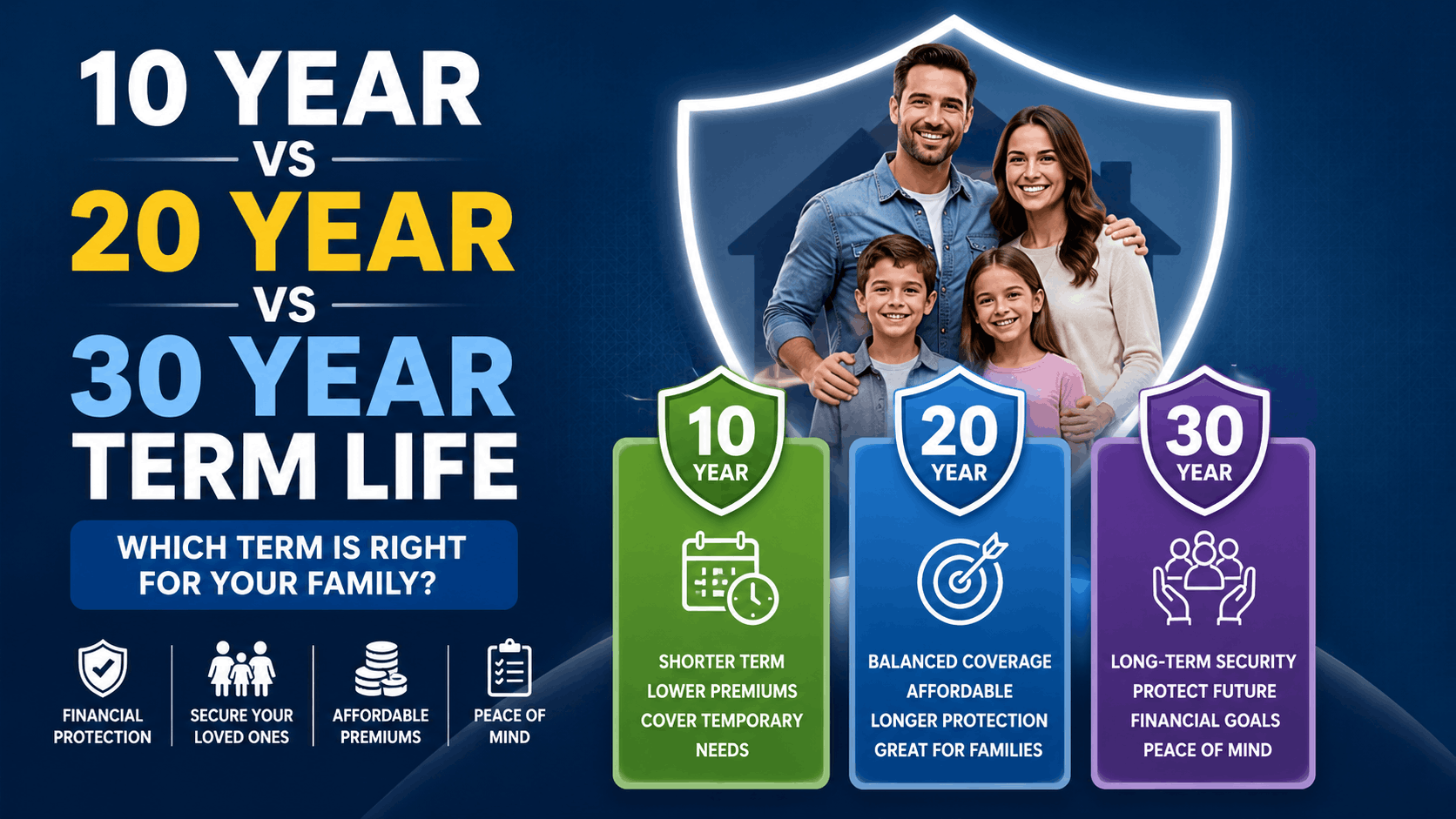
Choosing term life insurance isn’t just about picking a coverage amount, it’s about picking the right length of protection. Get the term too short, and your family could be left exposed right when they need coverage most. Get it too long, and you might be paying for protection you no longer need. This guide breaks down 10-year, 20-year, and 30-year term life insurance so you can match your policy to your actual financial timeline.
What Is Term Life Insurance?
Term life insurance provides coverage for a specific period, or “term.” If you pass away during the policy term, your beneficiaries receive the policy’s death benefit. Unlike permanent life insurance, term life insurance is temporary by design, it’s built to protect your family through a defined stretch of financial responsibility, not for life.
Most term life policies offer level premiums, meaning the cost of your coverage remains fixed for the entire term. That predictability is a big part of why term life is the most commonly purchased type of coverage, you can budget for it without worrying about rate hikes mid-policy.
10-Year Term Life Insurance: Who It’s For
A 10-year term life insurance policy has a level premium and a specific death benefit that stays locked in for the full decade. It’s the shortest common term length, and usually the cheapest.
Best suited for
- People nearing retirement who only need temporary protection
- Anyone whose major debts will likely be paid off soon
- People “layering” or “staggering” multiple policies to match different financial obligations
- Bridge coverage while income or insurability is expected to improve
Real cost example
For a 40-year-old male, the average annual premium for $500,000 of coverage may cost around $201 for a 10-year term, significantly less than longer terms at the same coverage level.
The tradeoff
Coverage ends after 10 years. If you still need protection after that, renewal or new coverage is priced at your new (older) age, and if your health has changed, new underwriting can become expensive or even unavailable.
20-Year Term Life Insurance: The Middle Ground
If 10 years feels too short and 30 feels excessive, 20-year term is where most families land.
Best suited for
- Parents of young children who want coverage through school-age years
- Homeowners paying off a mortgage
- Anyone wanting long-term protection without committing to 30 years of premiums
Why it’s popular
One of the best things about a 20-year term policy is that it tends to be very cost-effective, research from LIMRA found that most people believe term life insurance costs three times more than it actually does. As a real example: a 30-year-old non-smoking female can get $1,000,000 of coverage for just $48 a month.
The tradeoff
If you think you may need coverage beyond 20 years, the monthly premium for a 30-year term will be somewhat higher, but it will typically cost less in the long run than reapplying for new 10-year coverage after your 20-year policy expires, since price naturally goes up as you get older.
30-Year Term Life Insurance: Locking In Long-Term Protection
A 30-year term is the longest common option, ideal for people who want to “set it and forget it” for three decades.
Best suited for
- Young parents who want coverage through their children’s high school and college years
- People with a 30-year mortgage who want the term to match the loan
- Cost-conscious buyers who want long-term protection without paying for whole life insurance
- People with co-signed debt that will take decades to pay off
Real cost example
Using the same 40-year-old male, $500,000 coverage profile: a 30-year term may cost around $580 a year, notably more than the $201 a year 10-year term equivalent, because the longer the term, the more risk the insurer takes on.
The tradeoff
Higher monthly premiums than 10- or 20-year options. But locking in a rate now means you won’t have to shop around or worry about your premium increasing for the next three decades, even if your health changes later.
Side-by-Side Comparison
| Feature | 10-Year Term | 20-Year Term | 30-Year Term |
|---|---|---|---|
| Best for | Short-term needs, layering policies, near-retirement | Mortgage, young children, mid-length goals | Long-term protection, young families, co-signed debt |
| Monthly cost | Lowest | Moderate | Highest |
| Sample annual premium (40M, $500K) | ~$201/year | Mid-range | ~$580/year |
| Risk to insurer | Lowest | Moderate | Highest |
| Ideal life stage | Late career / near-retirement | Early-to-mid family life | Early career / new family |
| Renewal risk | Higher (reprices sooner) | Moderate | Lowest (locked longest) |
Why Term Length Affects Cost So Much
Understand that the longer the term, the more risk for the insurance company, the insurer is guaranteeing your rate for a longer window, during which your health and mortality risk will naturally change. That’s why, compared to 10- or 20-year term life policies, a 30-year term life insurance policy generally costs more per month.
But here’s the catch many people miss: choosing a shorter term than you actually need can backfire. If you have a 30-year mortgage, a 10-year term wouldn’t be long enough to cover it if something happened to you partway through, and reapplying later, especially after a health change, can mean a much higher premium than if you’d locked in the longer term from the start.
Common Mistakes When Choosing a Term Length
- Choosing a shorter term to save money now, this can leave dependents without coverage for education costs, debt repayment, or other major expenses that extend beyond the policy’s end date
- Choosing a longer term than you actually need, leads to unnecessary premium payments for protection you may not use
- Not accounting for future insurability, health can change, and a new policy taken out later in life (after a shorter term expires) may cost significantly more or be harder to qualify for
- Ignoring the “staggering” strategy, some people benefit from carrying more than one policy at once (for example, a large 20-year policy plus a smaller 30-year policy) to match different phases of financial responsibility
How to Decide: A Quick Framework
Ask yourself these three questions:
- When will my major financial obligations end? Mortgage payoff, kids finishing college, debts clearing
- How long do I want to lock in my current premium rate? Locking in while young and healthy protects you from future rate increases due to age or health changes.
- Am I trying to cover one long-term need, or several overlapping short-term ones? If the latter, layering a 10-year and a 20-year (or 30-year) policy together might make more financial sense than one long policy sized for your peak coverage need.
If your long-term goals include more than temporary protection, for example, wanting cash value growth alongside coverage, it’s also worth understanding how term coverage compares to a permanent option like whole life insurance before you commit either way.
Frequently Asked Questions
- Is 20-year or 30-year term life insurance better?
- It depends on your timeline. A 20-year term is usually cheaper and fits people whose major obligations (like a mortgage or kids’ school years) wrap up within two decades. A 30-year term costs more monthly but locks in your rate longer, which can save money overall if you’d otherwise need to reapply for new coverage later at an older age and higher risk class.
- Can I switch term lengths mid-policy?
- Generally, no, the term length is fixed when you buy the policy. However, many term policies include the option to convert to permanent coverage within a certain window, and some people choose to layer multiple policies of different lengths instead of switching.
- What happens if I outlive my term policy?
- If you outlive the policy, it typically expires without a payout, and coverage ends unless you renew or apply for a new policy, which will be priced based on your age and health at that time.
- Is a 10-year term ever a good choice for someone with young children?
- Usually not as a sole policy, 10 years often isn’t long enough to cover the years until children are financially independent. It’s more commonly used as a short-term bridge or layered alongside a longer policy.
Choosing between 10-, 20-, and 30-year term life insurance comes down to matching your coverage length to your actual financial timeline, not just picking the cheapest monthly premium. Future Proof Life Insurance can help you compare term lengths side by side and find the coverage window that actually fits your family’s future.