
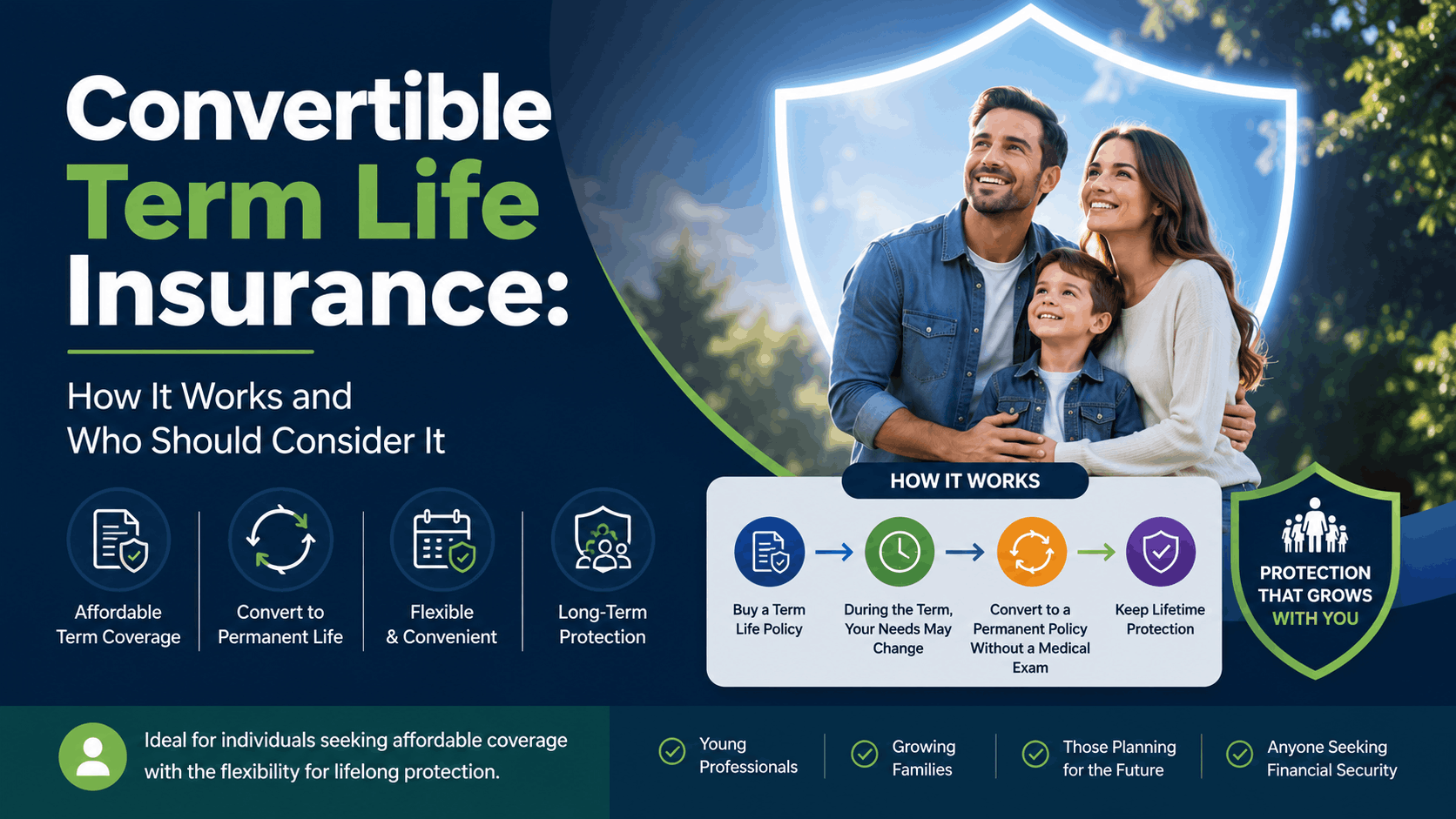
Term life insurance is popular because it’s simple and affordable, you pick a coverage amount, lock in a term length, and pay a level premium for the years you actually need protection. But what happens when that term ends and you still want coverage? That’s where convertible term life insurance comes in. It gives you the flexibility of term coverage today, with the option to switch to lifelong protection later, without starting the underwriting process over from scratch.
This guide breaks down exactly how conversion works, what it costs, and who should (and shouldn’t) consider it.
What Is Convertible Term Life Insurance?
Convertible term life insurance is a type of term policy that includes the option to convert to a permanent life insurance policy before your term ends, typically without a new medical exam or fresh evidence of insurability. In plain terms: you get the low cost of term life now, with a built-in escape hatch to lifelong coverage later, if your needs change.
How it differs from standard term life insurance
Standard term life insurance simply expires at the end of the term. If you outlive the policy and haven’t renewed or converted it, coverage ends and there’s no payout, no cash value, nothing carried forward. Convertible term life adds a provision, either built into the policy or attached as a rider, that lets you exchange that expiring coverage for a permanent policy instead of letting it lapse.
How it differs from permanent life insurance
Permanent life insurance (like whole or universal life) is designed to last your entire life and typically builds cash value over time. Convertible term isn’t permanent coverage from day one, it starts as temporary, affordable term protection, and only becomes permanent if and when you exercise the conversion option.
How Does Convertible Term Life Insurance Work?
The conversion privilege or rider explained
Most level term life policies, the kind where your premium and death benefit stay fixed for 5, 10, 20, or 30 years, can include a conversion privilege. This is either:
- Built directly into the policy as a standard provision, or
- Added as a rider (sometimes called a term conversion rider) that you select when purchasing
Either way, it works the same: if you don’t exercise it, your policy simply continues protecting you as normal term coverage until the term ends. Many policyholders don’t even realize they have this option until they go looking for it.
Conversion without a new medical exam
This is the single biggest advantage of convertible term. Converting to a permanent policy generally doesn’t require a new medical exam or updated evidence of insurability, meaning your health today doesn’t factor into whether you qualify.
How your original health rating carries over
When you convert, your insurer typically bases your new premium on the health rating you had when you first bought the term policy, not your current health. If your health has declined since then, this can be a major financial win, since you’re effectively locking in the rate of a healthier version of yourself.
The Conversion Period: When You Can Convert
Typical conversion window
Conversion isn’t available forever. It usually has to happen before your term ends, or before you turn 70, whichever comes first, though exact rules vary by insurer.
Built-in provision vs. added conversion rider
| Type | How It Works |
|---|---|
| Built-in conversion provision | Included automatically in the policy, no extra cost or selection needed |
| Term conversion rider | Added on as an optional feature, may involve a small additional premium |
Not every term policy includes conversion by default, some insurers offer multiple term products, only some of which carry conversion rights. It’s worth confirming this detail before you buy, not after you need it.
What Can You Convert Into?
Whole life insurance
The most common conversion target. If lifelong protection and predictable, guaranteed cash value growth are what you’re after, converting into a whole life insurance policy is usually the most straightforward path, your death benefit continues, and you gain the savings component permanent policies are known for.
Universal life insurance / IUL
Some insurers also allow conversion into universal life or indexed universal life, which offer more flexibility in premium payments and cash value growth tied to market index performance, along with living benefits for chronic or critical illness in some cases.
Partial vs. full conversion
You don’t always have to convert the entire policy. Many insurers allow you to convert just a portion of your term coverage into permanent insurance, keeping the rest as term, useful if you want some lifelong coverage without fully replacing your lower-cost term protection.
Convertible Term vs. Renewable Term
These two get confused constantly, but they solve different problems.
| Feature | Convertible Term | Renewable Term |
|---|---|---|
| What it does | Switches term coverage to permanent coverage | Extends term coverage for another term period |
| Medical exam required | Usually no | Usually no, but premium reprices at current age |
| Premium after the change | Based on original health rating | Based on current age (and sometimes health) |
| Coverage type after change | Permanent (whole/universal life) | Still term, just extended |
| Best for | Wanting lifelong coverage or locking in your original rate | Wanting a bit more term coverage without switching policy types |
Bottom line: conversion changes your coverage type, renewal just extends your existing term at a new, usually higher, price.
How Much More Does Conversion Cost?
Why premiums jump after converting
Permanent life insurance costs more than term because it lasts your entire life and builds cash value, there’s no getting around that. When you convert, expect your premiums to increase significantly compared to what you were paying for term, since converted policy premiums could run five to 15 times higher, depending on your age at conversion.
Worked example
| Scenario | Approximate Monthly Cost |
|---|---|
| Term life premium (before conversion) | Lower, fixed rate based on original term |
| Converted permanent policy premium | 5 to 15x higher than the original term premium |
The exact multiplier depends heavily on your age at the time of conversion, the earlier you convert, the smaller the jump tends to be.
Pros and Cons of Convertible Term Life Insurance
Advantages
- Flexibility to move from temporary to lifelong coverage as your needs evolve
- No new medical exam required to convert
- Locks in your original health rating, even if your health has since declined
- Option for partial conversion, so you’re not forced into an all-or-nothing decision
- Access to cash value accumulation once converted to a permanent policy
Disadvantages
- Converted premiums are substantially higher than term premiums
- Conversion window is time-limited, miss it, and the option disappears
- Not all term policies include conversion rights by default
- Requires proactively tracking your policy’s conversion deadline
Who Should Consider Converting?
- People whose health has declined since buying term: converting lets you lock in your original, healthier rating instead of facing new underwriting
- People who now want lifelong coverage: life changes (new dependents, estate planning goals) can shift your need from temporary to permanent protection
- People wanting a stable, predictable long-term cost: permanent premiums, once locked in, don’t reprice based on age or health the way a new policy would
- People interested in building cash value: a converted policy accumulates value that can potentially be borrowed against or withdrawn later
Who Should NOT Convert
- People who only need temporary coverage: if your mortgage or dependent-support timeline still lines up with your original term, converting adds cost without added benefit
- People still in excellent health who are comfortable re-shopping: if your health hasn’t changed, a fresh term policy at market rates may end up cheaper than a converted permanent policy
- People prioritizing the lowest possible monthly premium: permanent coverage will almost always cost more per month than staying on term
How to Convert Your Term Policy: Step-by-Step
- Contact your agent or insurer to confirm your policy includes a conversion privilege
- Check your conversion deadline, typically before the term ends or by age 70
- Decide between full or partial conversion based on how much permanent coverage you actually want
- Choose your permanent policy type, whole life, universal life, or IUL, depending on what your insurer offers
- Review your new premium before finalizing, since it will be notably higher than your term rate
- Complete the conversion paperwork, no medical exam needed in most cases
Frequently Asked Questions
- Do I need a medical exam to convert my term policy?
- No, most insurers allow conversion without a new medical exam or updated evidence of insurability, which is the core advantage of choosing a convertible policy in the first place.
- Can I convert only part of my term coverage?
- Yes, in many cases. Insurers commonly allow partial conversion, letting you convert a portion of your death benefit to permanent coverage while keeping the rest as term.
- What happens if I don’t convert before the deadline?
- If the conversion window closes, typically at the end of the term or by age 70, you lose the option to convert without new underwriting. Your term policy will either expire or need to be renewed/replaced at your current age and health status.
- Is convertible term life insurance more expensive than regular term?
- The term premium itself is often similar. The cost difference comes if and when you actually convert, permanent premiums after conversion can run significantly higher, sometimes 5 to 15 times your original term rate.