
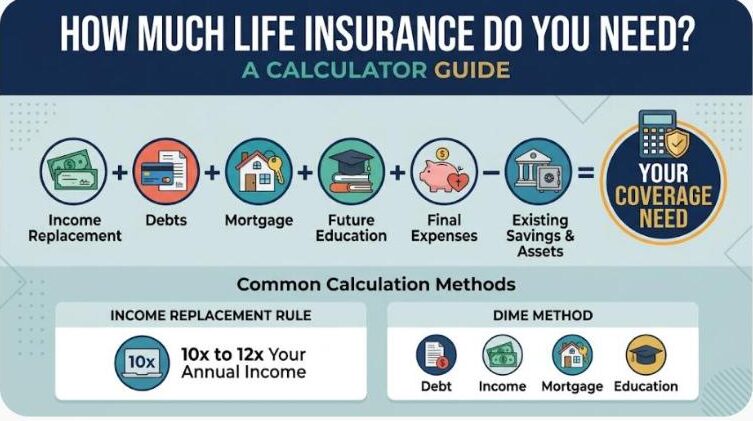
Buying life insurance without calculating how much you actually need is one of the most common and costly mistakes families make. Too little coverage can leave your dependents financially exposed, while too much means overpaying on premiums for years. This guide walks through the most reliable methods for calculating the right amount of life insurance for your specific situation.
Why Guessing at a Coverage Amount Is Risky
Many people choose a life insurance amount based on a round number, such as $250,000 or $500,000, without connecting it to their actual financial obligations. The right amount depends on your income, debts, dependents, and long-term goals, not a generic figure. Using a structured calculation method helps you arrive at a number you can defend and adjust as your life changes.
Method 1: The Income Replacement Rule
A common rule of thumb is to buy coverage equal to 10 to 15 times your annual income. For example, someone earning $75,000 a year might consider $750,000 to $1,125,000 in coverage. This method is quick to apply, but it does not account for your specific debts, savings, or number of dependents, so it works best as a starting point rather than a final answer.
Method 2: The DIME Method
The DIME method is a more detailed, step-by-step calculation that adds up four categories:
- Debt: Add up all non-mortgage debt, including credit cards, auto loans, and student loans.
- Income: Multiply your annual income by the number of years your family would need support, often until your youngest child becomes financially independent.
- Mortgage: Add your remaining mortgage balance so your family is not forced to move.
- Education: Add estimated future education costs for your children, such as college tuition.
Adding these four figures together gives a coverage estimate tailored to your actual obligations, then you subtract existing savings, investments, and any current life insurance to find the additional coverage you need.
Step-by-Step Example Calculation
| Category | Amount |
|---|---|
| Non-mortgage debt | $25,000 |
| Income replacement (10 years x $70,000) | $700,000 |
| Remaining mortgage balance | $220,000 |
| Future education costs (two children) | $150,000 |
| Total need | $1,095,000 |
| Minus existing savings and life insurance | -$95,000 |
| Recommended coverage | $1,000,000 |
Method 3: The Human Life Value Approach
This method estimates the present value of your future lifetime earnings, factoring in your income, expected career length, and a discount rate for inflation and investment growth. It is more complex and typically used by financial advisors, but it can provide a more precise figure for high earners or those with irregular income.
Factors That Increase How Much Coverage You Need
- Young children who are many years from financial independence
- A non-working spouse or one earning significantly less than you
- A large mortgage or other long-term debt
- Plans to fund college or private school education
- Dependents with special needs requiring long-term care
Factors That Decrease How Much Coverage You Need
- Significant savings, investments, or existing life insurance
- A working spouse with their own income and benefits
- No dependents or a mortgage that is already paid off
- Employer-provided group life insurance, though this is usually only one to two times your salary and may not be portable if you change jobs
How Much Life Insurance Do You Need by Life Stage?
Young and Single
If no one depends on your income, a smaller policy to cover final expenses, any debt, and co-signed loans may be sufficient.
Newly Married or New Parents
This is typically when coverage needs are highest, since a spouse, mortgage, and young children all depend on continued income. Coverage of 10 to 15 times income, calculated more precisely with the DIME method, is common at this stage.
Midlife with Teenagers
As the mortgage balance shrinks and savings grow, required coverage often decreases, though upcoming college costs can offset some of that reduction.
Empty Nesters and Retirees
Coverage needs often drop significantly once children are financially independent and the mortgage is paid off, though some people maintain a policy for estate planning, final expenses, or to leave a legacy.
How Term Length Affects the Amount You Need
A longer term, such as 30 years, locks in coverage through your highest-need years but costs more than a shorter term. Many people choose a term length that matches a specific milestone, such as the number of years until a mortgage is paid off or until their youngest child turns 22.
Common Mistakes to Avoid
- Relying solely on an employer’s group life insurance, which usually ends if you leave your job
- Choosing a coverage amount based on affordability alone, rather than actual financial need
- Forgetting to include future costs, such as college tuition, in the calculation
- Failing to revisit coverage amounts after major life events like marriage, a new child, or a new mortgage
Frequently Asked Questions
Is 10 times my salary enough life insurance?
Ten times your salary is a reasonable starting point for many people, but it does not account for specific debts, number of dependents, or future expenses like education. The DIME method typically provides a more accurate, personalized number.
How much life insurance does a stay-at-home parent need?
Even without an income, a stay-at-home parent’s death would likely require the surviving spouse to pay for childcare, household management, and other services. Many financial professionals recommend $250,000 to $500,000 or more, depending on the number and age of children.
Can I have too much life insurance?
Yes. Coverage far beyond your calculated need means paying unnecessary premiums for years. It is generally better to calculate your actual need and revisit it periodically than to significantly overbuy.
Should I include my mortgage in my life insurance calculation?
Yes, including your remaining mortgage balance helps ensure your family can stay in their home without taking on that debt alone if something happens to you.
How often should I recalculate how much life insurance I need?
It is a good idea to review your coverage every few years and after major life events, such as marriage, having a child, buying a home, or a significant change in income or debt.
Final Thoughts
There is no single number that fits every family, but working through the DIME method or a similar structured calculation gives you a defensible, personalized estimate rather than a guess. Once you have a target number, a licensed life insurance agent can help you compare term lengths and policy types to find coverage that fits both your needs and your budget.