
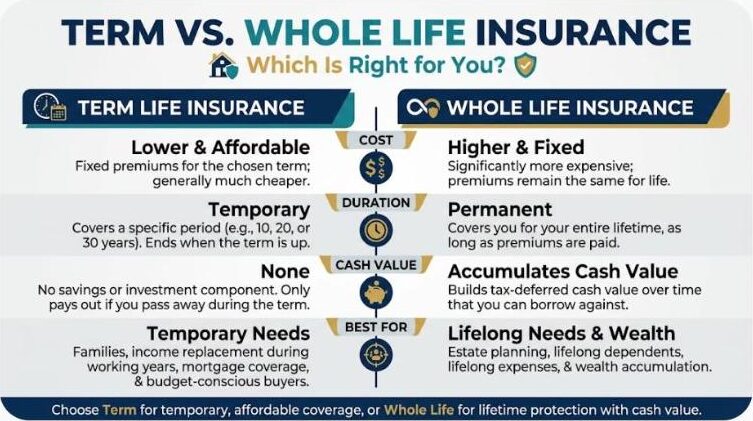
very different ways, cost very different amounts, and fit very different stages of life. This guide breaks down exactly how term and whole life insurance compare, so you can match the right policy to your budget, your health, and your long-term goals.
What Is Term Life Insurance?
Term life insurance provides coverage for a set period, typically 10, 15, 20, 25, or 30 years. If you pass away during that term, your beneficiaries receive a tax-free death benefit. If the term ends and you are still alive, the coverage simply expires unless you renew it, convert it, or buy a new policy, usually at a higher premium based on your age at that time.
Term insurance is often called “pure protection” because it has no savings or investment component. Every dollar of premium goes toward the cost of the death benefit, which is why term policies are the most affordable way to buy a large amount of coverage.
What Is Whole Life Insurance?
Whole life insurance is a type of permanent life insurance designed to last your entire life, as long as premiums are paid. It combines a guaranteed death benefit with a cash value account that grows slowly over time on a tax-deferred basis. Premiums are typically fixed for life, and many whole life policies, especially participating policies from mutual insurers, can also pay annual dividends.
Because whole life insurance never expires and includes a savings component, it costs significantly more than term insurance for the same death benefit, often five to fifteen times more.
Term vs. Whole Life Insurance: Key Differences
| Feature | Term Life Insurance | Whole Life Insurance |
|---|---|---|
| Coverage length | Set term (10-30 years) | Lifetime, as long as premiums are paid |
| Premiums | Lower, fixed during the term | Higher, fixed for life |
| Cash value | None | Yes, grows over time |
| Flexibility | Can often convert to permanent coverage | Can borrow against or surrender cash value |
| Best for | Income replacement, mortgage protection, temporary needs | Lifelong needs, estate planning, cash value accumulation |
Pros and Cons of Term Life Insurance
Advantages
- Lower premiums mean you can afford a larger death benefit
- Simple to understand and compare across insurers
- Many policies allow conversion to permanent coverage without a new medical exam
- Ideal for covering specific financial obligations like a mortgage or a child’s education
Disadvantages
- Coverage ends when the term expires
- No cash value or savings component
- Renewing after the term can be expensive due to age and health changes
Pros and Cons of Whole Life Insurance
Advantages
- Coverage never expires as long as premiums are paid
- Builds guaranteed cash value you can borrow against or withdraw from
- Premiums stay level for life, unaffected by age or health changes later on
- Can support estate planning, final expenses, and wealth transfer goals
Disadvantages
- Premiums cost far more than term insurance for the same coverage amount
- Cash value grows slowly in the early years
- Less flexibility if your budget changes
How Much Does Each Type Cost?
Cost depends on your age, health, gender, and the amount of coverage, but as a general rule, a healthy 35-year-old might pay around $20 to $35 a month for a $500,000, 20-year term policy. A whole life policy with the same $500,000 death benefit could cost $400 to $600 a month or more for the same person, because part of every premium funds the lifelong guarantee and the cash value account.
This cost gap is the main reason financial professionals often recommend “buy term and invest the difference” for people who are primarily focused on income replacement during their working years.
Which Is Right for You?
Term life insurance tends to make sense if you:
- Need coverage to replace income during your working years
- Want to protect a mortgage, car loan, or other debt with an end date
- Are on a tighter budget but still need a large death benefit
- Plan to build wealth separately through retirement accounts or investments
Whole life insurance tends to make sense if you:
- Want coverage that never expires, no matter how long you live
- Are using life insurance as part of estate planning or to cover final expenses
- Want a guaranteed, tax-deferred savings component alongside protection
- Have already maxed out other tax-advantaged savings vehicles
Can You Have Both Term and Whole Life Insurance?
Yes. Many households “layer” policies, pairing a smaller whole life policy to cover lifelong needs like final expenses with a larger term policy to cover temporary needs like income replacement while raising children or paying off a mortgage. This approach can provide strong protection while keeping overall premiums manageable.
How to Decide: A Simple Checklist
- Do you need coverage forever, or only for a specific number of years?
- Is your top priority affordability, or guaranteed cash value growth?
- Do you have dependents who rely on your income right now?
- Have you already built an emergency fund and retirement savings?
- Would you rather invest the premium difference yourself, or let an insurer guarantee growth?
If you are still unsure, a licensed life insurance agent can run quotes for both term and whole life policies so you can compare real numbers side by side before deciding.
Frequently Asked Questions
Is whole life insurance a good investment?
Whole life insurance is better thought of as a protection product with a conservative, guaranteed savings feature than as a high-growth investment. Its cash value typically grows more slowly than stock market investments, but it comes with guarantees and tax advantages that investments do not offer.
Can I convert term life insurance to whole life insurance?
Many term policies include a conversion rider that lets you switch some or all of the coverage to a permanent policy with the same insurer, often without a new medical exam, as long as you convert before the rider’s deadline or the end of the term.
Which is cheaper, term or whole life insurance?
Term life insurance is almost always cheaper because it only covers a set period and has no cash value component. Whole life insurance costs more because the premium also funds a lifelong guarantee and a growing cash value account.
What happens to term life insurance if I outlive the policy?
If you outlive a term policy, the coverage simply ends. Some term policies offer a “return of premium” option that refunds the premiums you paid, but these policies cost more than standard term coverage.
Do I need life insurance if I am single with no dependents?
If no one depends on your income, a small policy to cover final expenses and any debts may be enough. Your needs can change quickly, so it is worth revisiting your coverage after marriage, having children, or buying a home.
Final Thoughts
There is no single “best” choice between term and whole life insurance, only the choice that best fits your budget, your health, and how long you need the coverage to last. Many people start with affordable term coverage during their highest-need years and consider adding permanent coverage later as their goals evolve. The most important step is simply getting covered, since the right amount of life insurance, in place today, is worth far more than the perfect policy you never bought.